Where everyday is the weekend…

Plumbing, Electrical, Framing, Oh My!

2009 is long gone and the cottage still isn’t ready, but there has been some progress since the last update. The rough-in electrical inspection went very well. The inspector was in and out in no time and had only a handful of items he would like to see changed. I’ve made those changes, but I still have a few more things to wire, like the water heater, the water pump, and an outdoor motion detector light. Once that is done, hopefully by the end of February, I’ll get the inspector back in for the final inspection.

I’ve managed to dry fit all the drainage pipes. It really isn’t a lot of piping, but the planning involved for a plumbing project is much more detailed then I had expected. There was a lot of cutting and re-cutting and drilling and re-drilling before I got it to the state it is in now. About 2/3’s of it is glued together and I should be able to finish it up this weekend. I’ll get the plumbing inspector in to take a look at it and hopefully it’s up to par.

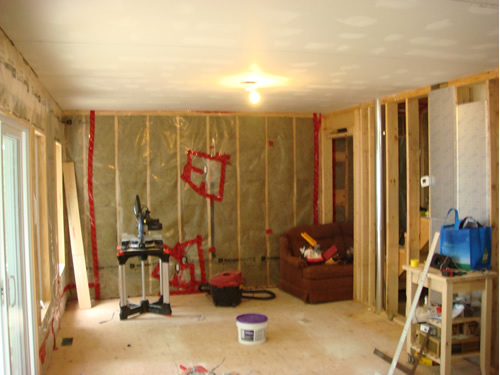
I had started insulating the upstairs bedrooms and attic when I found out that the framing needs to be inspected by the building inspector before the insulation is installed. I thought the insulation and vapour barrier needed to be in before the next inspection. Anyway I popped in the inspector’s office just to clarify. He told be to stop insulating and give him a call when the plumbing and heating ducts were in since those jobs typically tear up the framing.

I hired a heating contractor to come in and install a furnace. That was completed over the holidays and the propane was hooked up. So now I have heat, but because I can’t insulate the heat goes through the roof.

The plan now is to finish gluing the drainage pipes together, purchase an electric water heater and finish the wiring. Then I’ll schedule the plumbing inspector, the electrical inspector, and the building inspector to come and check everything out. If it’s all good I’ll finish insulating and put the vapour barrier up and then I’ll be able to turn the heat on.

Next step is to install all the incoming water lines.

Building a Cottage: Slowly But Surely

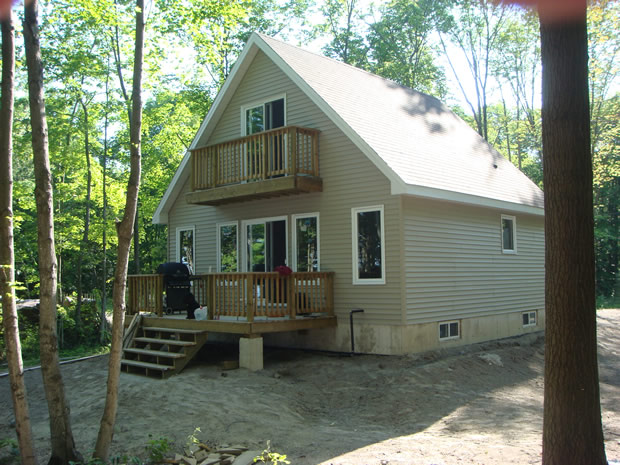
It’s been a pretty good year for the cottage so far even if it is cold and rainy every weekend.  There has been progress, particularly on the outside as you can see from the picture.  We decided to add two more windows to the lake side of the cottage for a few reasons.

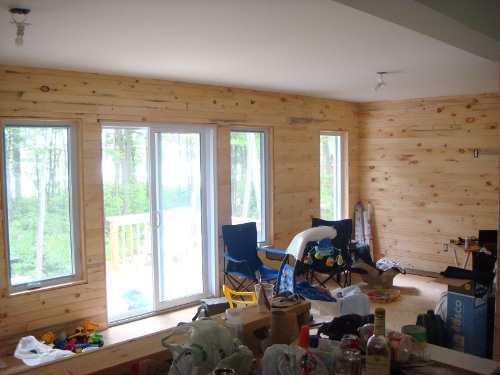
We will get a better view of the lake, increase air circulation, and most importantly add light to the dining and living rooms.  We found out after the cottage was built that the corners of the rooms were very dark.

We struggled with the decision to add the windows because we are on a tight budget and this wasn’t in the plans, but now that we have them in I’m very happy we made the right choice.

New Cottage!

As you can see we also had the siding installed.  I found a contractor in the area and he did a fantastic job for a decent price.  I’ll be calling on him again when it comes time to drywall.  Other little projects outside were adding stairs to the front and back decks.  We did a little landscaping and built a picnic table which turned out to be very good.  At least we have somewhere to sit and eat and play games now.  If you are interested in building a picnic table you can find the plans here.  The only outside projects left with respect to the building are to install exterior outlets and put up the eaves troughs.

The inside of the cottage is a whole different matter.  It is still bare studs, but I did have the basement floor poured in the spring.  I’ve run just about all my electrical wires to their boxes and have a rough inspection scheduled for Aug 19/2009.  Hopefully that goes smoothly and I can have power throughout the cottage rather than plugging and unplugging extension cords as I am now.  I’ve also almost completed my drainage and vent pipes for the plumbing.  A few more cuts and it will be dry fitted.  From there I have to level it, hang it, and then glue it all together.  I’ve met with both plumbing inspectors and both have been extremely nice and helpful.  That makes things much easier on a guy like me that is doing everything for the first time.  Once the drainage pipes are glued together I’ll run the flexible water supply pipes, no copper or soldering for me.  I don’t think that will be too much of a big deal, although I say that about everything, because I only have a kitchen sink, bathroom sink, toilet, and shower to run the pipes to.

I’ll be contacting a HVAC contractor soon to install the furnace, water heater, ducts and propane line.  Of course this will end up being way more then I’m going to anticipate, but it needs to be done before the winter comes.  If everything goes to plan I should be able to have the cottage in a state where we have electricity, plumbing, heating, and is insulated by the end of the year.  Which means by next summer it should be fully complete and I can start concentrating on my fishing!  Did I mention the fishing on my lake is great?  I will in an upcoming post.

Thanks for all the comments over the past months while I haven’t been doing much updating.  I’m especially enjoying all the comments about the Mantracker show!  They make me laugh.  Keep it up!

Home Renovation Tax Credit (HRTC)

Here’s some good news from the federal government with respect to their proposed budget.  They are proposing a temporary renovation tax credit for 2009.  Now this might not affect a lot of people, but for folks like myself that intended on spending money on building materials or services this is a nice little perk.

Here are the details from the Department of Finance Canada

The HRTC will apply to eligible home renovation expenditures for work performed, or goods acquired, after January 27, 2009 and before February 1, 2010, pursuant to agreements entered into after January 27, 2009.

The 15-per-cent credit may be claimed on the portion of eligible expenditures exceeding $1,000, but not more than $10,000, meaning that the maximum tax credit that can be received is $1,350.

The credit can be claimed on eligible expenditures incurred on one or more of an individual’s eligible dwellings. Properties eligible for the HRTC include houses, cottages and condominium units that are owned for personal use.

Renovation costs for projects such as finishing a basement or re-modelling a kitchen will be eligible for the credit, along with associated expenses such as building permits, professional services, equipment rentals and incidental expenses.

Routine repairs and maintenance will not qualify for the credit. Nor will the cost of purchasing furniture, appliances, audio-visual electronics or construction equipment.

Taxpayers can claim the HRTC when filing their 2009 tax return.

Cottage Building Costs‏

There have been some requests lately from readers that would like to follow the same steps I did in building a cottage and they are looking for costs to put a budget together.  I know where they are coming from because before I started all this I couldn’t find any costs or quotes or even a task list of things I would need to pay for.

So I thought I would list some of items I paid for and their approximate costs to help folks out.

Take into consideration regional prices, taxes and the size of the building.

cottagecosts.JPG

So here’s what I did:

  • Customized cottage kit from Home Hardware (1050sqft, 25’x25’ footprint, included drawings and materials for a cottage shell) - $27,000
  • Grading, Septic, Driveway (I had to bring in a lot of fill because of a high water table) - $17,000
  • Full Basement Foundation (8 inch poured concrete) - $10,000
  • Drainage Membrane for Foundation - $500
  • Tree Removal - $2,500
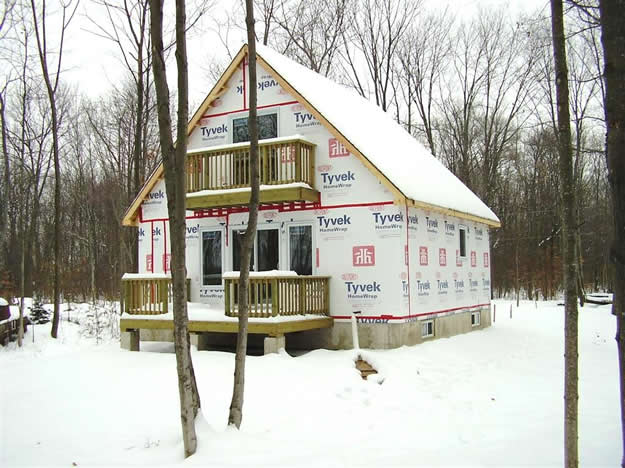
  • Framing Cottage (in a weather tight state, see picture) - $9,000
  • Shingling the Roof - $1,000
  • Temporary Electricity (power from the street to the cottage and a circuit panel installed) - $1,500
  • Building, Plumbing, Entrance Permits - $1,500

Estimates – Items I haven’t completed yet

  • Install Vinyl Siding - $2,000
  • Install Ducting, Propane lines, and Propane Furnace - $5000
  • Interior Materials (Drywall, Flooring, doors, cabinets, sinks, shower, toilet) - $6,000

DIY – Items I plan to do myself

  • Install electrical wiring throughout the cottage - ?
  • Install plumbing - ?

Total Approximate Cost of the project = $83,000+

Hope this helps and good luck!

Hiking Stick

Aluminum Hiking Stick

This light weight aluminum hiking stick extends from 28” to 57” and locks in place. The wrist strap has a thermometer and compass. The rubber tip is removable to expose a carbide tip which is great for slippery conditions.

Removing the knob on top reveals a camera mount which is excellent for taking steady wild life photos. In the shaft is a heavy spring that allows you to put a lot of pressure in the stick and have it cushion the force rather then your elbow or shoulder.

If you are a hiker of photographer you will love the versatility of this hiking stick.


Horseshoes

Here is another great outdoors weekend game. Horseshoes can be played by most people and in most locations. The only real limitations are that the horseshoes are 2.5 lbs and not everyone will be able to throw that weight with any consistency. That being said it is a great way to spend an afternoon with friends and family and is an excellent spectator sport for those not participating.

The Set:
A horseshoes set consists of 4 horseshoes weighing 2.5lbs each and 2 stakes 24” long.

Object of the Game:
Throw your horseshoes closer to the stake then your opponent to score points.

General Rules:
The game of horseshoes is broken down into innings, each consisting of 4 pitched horseshoes, 2 by each opponent.

The first player will pitch both shoes and then wait while the other contestant does the same. Each player must take care not to cross the foul line which is 3′ past the stake or risk having the thrown shoe deemed a foul disqualified from scoring.

Once points have been determined, players pick up their shoes and then begin the next inning, now throwing in the opposite direction.

Scoring:
In each inning, after all four shoes have been thrown, scoring is determined in the following manner. In order to be considered for points, a shoe must lie within 6″ (approximately the distance between the open ends of the shoe) from the stake - all shoes outside of this area score no points.

Of the shoes within this 6″ area around the stake, the closest shoe gets one point. If one player has two shoes closer than any of the opponents’, it’s worth 2 points.

Leaners are shoes which lean against the stake and worth 1 point are considered closer than any shoe which is not touching the stake but not closer than Ringers.

Ringers are shoes which completely encircle the stake so that the ends can be touched with a straight edge without touching the stake.

Ringers are worth 3 points each. If a player has both a ringer and the closest other shoe it would be worth 4 points.

Cancellation Scoring Anytime the shoes of opposing players are equal distance from the stake or of equal value they cancel each other out and score no points. For example: If both players have ringers they would cancel out and the next closest shoe within 6″ from the stake would score 1 point. Or if Player One has 2 ringers and Player Two has 1 ringer - two of the opposing ringers would cancel out and Player One would score 1 ringer for 3 points.

Winner of the Game is the first player or team to reach the predetermined point total.

Doubles Play:
Four players can play horseshoes in teams of two players each. Players of each team pitch from opposite ends of the court against an opposing team. The points of the players of each team are added together and players do not change sides after each inning. Otherwise, doubles play is no different than conventional singles play.

Winning the Game:
In backyard play, it is not uncommon to play to 15 points. The winner of the Game is the first player or team to reach the predetermined point total.

The Court:
Horseshoes Court

Hotdog Spiders

This is one of the simplest recipes and a tradition for me around a campfire.

Prep time: 1 min

Ingredients: 1 thawed hotdog

Instructions:

Make a straight cut starting from one end of the hotdog 1/3 of the way down towards the center. Rotate the hotdog 90 degrees and make another cut so that a cross is made when looking at the end. Repeat these steps on the other side of the hotdog.

Stick your Telescoping Fork right in the middle of the hotdog. Now roast the hotdog over the fire by turning the fork as if it were a spit. As the hotdog cooks the ends of the hotdog will curl creating the spider effect.

This is a lot more fun to watch, the hotdog cooks quicker, and it gets a little crunchy!

Telescoping Campfire Fork

If you are planning on having a campfire this year and have a tradition of roasting marshmallows or hot dogs, like we do, then you will want to get at least one of these Telescoping Forks.

The fork extends from 12” to 34” giving you more then enough clearance from the fire so that your hands don’t get burnt. The fork is far better then finding a stick in the woods since it is usually difficult to find the ideal “roasting stick”. If you are concerned about bacteria you know that the fork is clean.

Advice:

You’ll probably want to buy at least two of these if you will be with a group of people. Once I pull this fork out everyone wants to scrap their sticks and use my fork!

Make sure you let people know that the fork is not to be used as a fire poker. There have been many times that someone moves logs around in the fire with the fork and I end up with ash on my marshmallows.

When I’m at a campfire with this fork I like to make Hotdog Spiders. Find out how to make them in the recipe section.

Telescoping Campfire Fork

Bocce Ball

Bocce Ball – The greatest weekend outdoor game

For anyone that has not played bocce ball they should try it when they get the chance. Anyone can play, young or old, which makes it a great family and get-together-game. It can be played virtually anywhere on any terrain. You will be limited only by your imagination.

The Set:
A bocce ball set includes 8 bocce balls and 1 pallino. In some sets there will also be a type of measuring device. Depending on the set, bocce balls will have 4 different colours and 2 balls per colour. Other sets will only have 2 colours, but will have 2 types of markings (circles and squares) within a colour. The pallino will always be white.

Object of the Game:
To get your bocce balls closest to the pallino.

Number of Players:
2 teams consisting of 1 or 2 players each

General Rules for Recreational Players:
Flip a coin to see which team gets to throw the pallino first. The team that throws the pillion will throw the first bocce ball. That team will be considered closest to the pallino, since no other balls have been thrown, and the next team will attempt to throw one of their bocce balls closer then their opponent. If that team is closest to the pallino then play goes back to the first team and shots will continue to alternate in this manner. If the second team’s first throw is not closer to the pallino then the second team will continue to throw until they are closer or run out of balls.

Once all the balls have been thrown the team closest to the pallino receives one point for every ball that is closer then the closest opponents ball

Winning the Game:
The first team to reach 12 points is the winner.

The Court:
For those that want to take this a little more seriously and have the time and means to create a court here are the dimensions.

Bocce Ball Court

Second Harvest - Turkey Dinner For Christmas

Second Harvest, Christmas Food, Christmas Dinner

Christmas isn’t far away now and I’m sure a lot of you are making plans for Christmas dinner.  This year you might want to help provide some food for those that can’t afford a turkey dinner.  Second Harvest is an organization that helps feed hungry people by picking up and preparing excess fresh food and delivering it daily to social service agencies in Toronto.

This weekend and next is Second Harvest’s 6th annual turkey drive.  Second Harvest volunteers will be at local grocery stores collecting donations and turkeys.  Those that would like to donate can simply buy a turkey at the grocery store and hand it to the Second Harvest volunteer.  There is no need to drive anywhere else and lug a turkey around town.

If you live in the Toronto area and would like to donate or volunteer you can get more information at Second Harvest’s website.  www.secondharvest.ca

Merry Christmas and Happy New Year!

Next Page »

Royal Caribbean Cruise Line